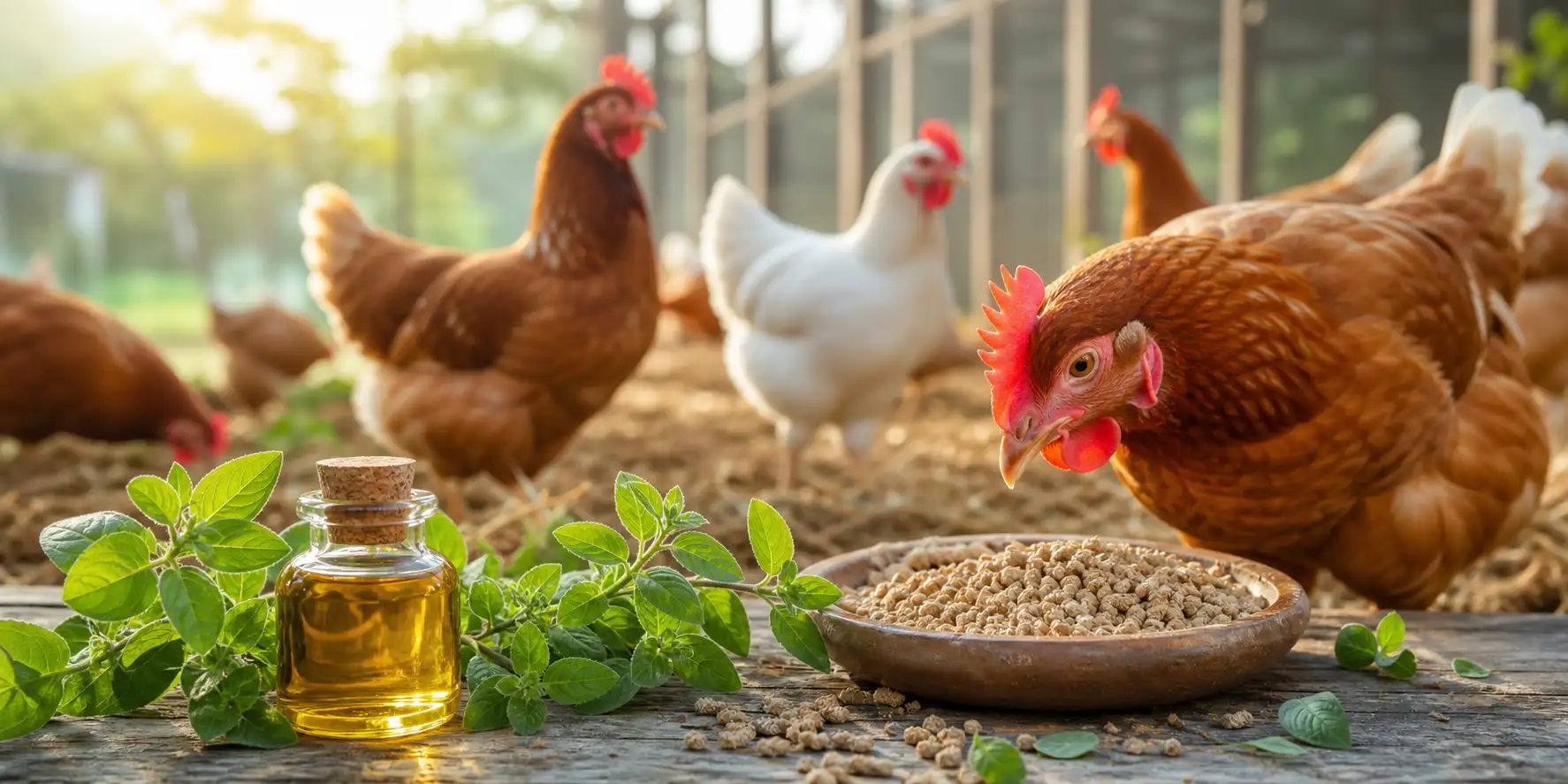
Oregano Oil as a Natural Feed Supplement for Poultry
Oregano oil has become one of the most popular natural feed additives in poultry production. I started experimenting with it around 2017, initially skeptical. The natural products market is full of things that sound good on paper but fail on the farm. Oregano oil turned out to be one that actually delivers.
The Active Compounds
The antimicrobial activity of oregano oil comes primarily from two phenolic compounds: carvacrol and thymol. Carvacrol is the main active ingredient, typically making up 60-75% of the essential oil. Thymol contributes another 5-15%. Together, they disrupt bacterial cell membranes, causing cell contents to leak out and killing the bacteria.
The minimum inhibitory concentration (MIC) of carvacrol against common poultry pathogens is:
- Salmonella enteritidis: 0.25-0.5 mg/ml
- Clostridium perfringens: 0.125-0.25 mg/ml
- E. coli: 0.5-1.0 mg/ml
- Campylobacter jejuni: 0.125-0.5 mg/ml
These numbers mean oregano oil is genuinely antimicrobial. But the concentrations needed for a therapeutic effect in the gut are higher than what feed can reasonably deliver.
Forms Available
There are three main product forms on the market:
- Powdered oregano leaves: 1-3% carvacrol content. Cheap but weak. I do not recommend this for anything other than minor gut health support.
- Essential oil on a carrier: 5-20% oregano oil coated on a calcium carbonate or vermiculite carrier. This is the most common form. A typical product contains 5% oregano oil (which itself is 60-70% carvacrol).
- Encapsulated oregano oil: Protected from the upper gut, released in the small intestine. This is more expensive but more effective because the active compounds reach the lower gut intact.
I use encapsulated forms for therapeutic applications and carrier-based forms for general gut health support.
Inclusion Rates and Results
For general gut health, I use 100-200 grams per ton of a 5% oregano oil product. This delivers roughly 5-10 grams of actual oregano oil per ton of feed. At these levels, I typically see:
- 1-3 point improvement in feed conversion
- Reduced Clostridium perfringens counts in the ceca
- Improved litter quality (drier, less ammonia)
- Minor improvement in mortality (0.3-0.5% reduction)
For therapeutic use during a coccidiosis or enteritis challenge, I increase to 300-500 grams per ton for 7-10 days. At these higher levels, oregano oil has shown efficacy comparable to some antibiotic growth promoters.
I participated in a trial where oregano oil at 400 g/ton was compared to bacitracin methylene disalicylate (BMD) in broiler diets. The oregano group had 1.72 FCR versus 1.70 for BMD the difference was not statistically significant. Both were better than the unsupplemented control at 1.78 FCR.
Palatability Concerns
Oregano oil has a strong flavor. At levels above 300 g/ton in starter feeds, I’ve seen reduced feed intake for the first 3-5 days. Chicks seem to avoid the strong oregano taste initially. They adapt within a week, but early growth can be slightly depressed.
Two solutions I’ve used: (1) gradual introduction, starting at 100 g/ton and increasing to target levels over 5-7 days; (2) limiting higher levels to grower and finisher phases when feed intake is well established.
Combination with Other Additives
Oregano oil works synergistically with several other natural additives:
- Organic acids (formic, propionic, butyric): The combination is more effective than either alone. The acids lower gut pH, making the environment more favorable for the phenolic compounds.
- Probiotics: Oregano oil reduces pathogen levels, while probiotics support beneficial bacteria. They complement each other well.
- Yucca extract: The combination improves litter quality better than either alone.
I typically include oregano oil with organic acids in antibiotic-free broiler programs. The two together provide a good baseline of gut health support.
Regulation and Labeling
In the US, oregano oil is generally recognized as safe (GRAS) for use in poultry feed. There is no withdrawal period. In the EU, oregano oil is permitted as a feed additive under certain regulations. The key in both markets is to use products from reputable suppliers that provide standardized carvacrol content.
One issue I’ve encountered is product variability. I tested five different commercial oregano oil products in 2022 and found carvacrol content ranging from 4.2% to 18.7% despite all being labeled as 5% oregano oil. Third-party testing is essential.
Practical Recommendation
For a standard antibiotic-free broiler program, I recommend:
- Grower/finisher: 200 g/ton of a standardized 5% oregano oil product
- During disease challenge: Increase to 400 g/ton for 7-10 days
- Always use from a supplier with third-party potency analysis
Oregano oil is not a replacement for good management. But as part of a comprehensive gut health program, it consistently performs.