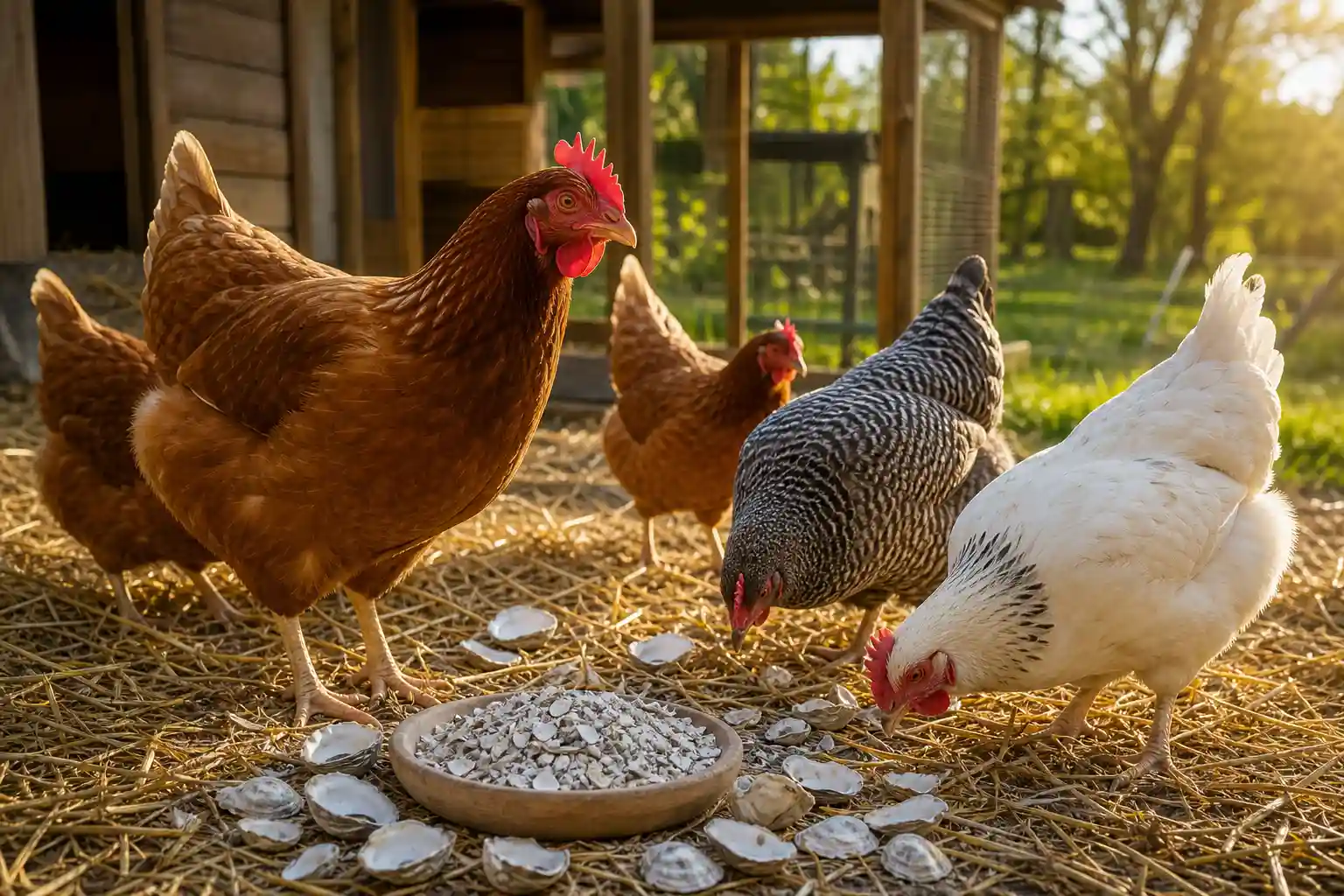
Oyster Shell as a Calcium Source for Poultry
Oyster shell has been used as a calcium source for poultry for decades. In my experience, it is one of the simplest but most effective supplements a poultry farmer can use, especially for laying flocks. The difference between oyster shell and ground limestone is not just in cost or calcium content. It’s about how the bird uses the calcium.
Why Oyster Shell Is Different
The main difference between oyster shell and limestone is the structural solubility. Oyster shell has a crystalline structure that dissolves more slowly in the gizzard compared to ground limestone. This slower dissolution means calcium is released gradually over several hours, particularly during the night when the hen is forming the eggshell.
A laying hen’s shell formation cycle runs on a roughly 24-hour schedule. The egg spends about 20 hours in the reproductive tract, with most of the shell deposition happening during the dark hours. Shell formation requires a steady supply of calcium during the night when the hen is not eating.
Fine limestone particles pass through the digestive tract quickly and are gone within 2-4 hours. Larger oyster shell particles (2-4 mm) can be retained in the gizzard for 8-12 hours, releasing calcium throughout the dark period.
Research Data
A 2020 study compared feeding 100% fine limestone versus a 50:50 blend of limestone and oyster shell to laying hens aged 45-65 weeks. The results were clear:
| Parameter | 100% Limestone | 50:50 Blend | Difference |
|---|---|---|---|
| Eggshell thickness (mm) | 0.345 | 0.358 | +3.8% |
| Breaking strength (N) | 32.1 | 34.6 | +7.8% |
| Cracked eggs (%) | 5.2 | 3.8 | -27% |
| Calcium retention (%) | 52 | 58 | +12% |
The calcium retention improvement is worth noting. The hens absorbed more of what they consumed, which means lower daily calcium intake is needed when large-particle calcium is used.
In another study from North Carolina State University, the calcium solubility score (a measure of how quickly the particle dissolves) was:
- Fine limestone (<0.5 mm): 85% solubility score
- Medium limestone (0.5-2.0 mm): 55% solubility score
- Coarse limestone (2-4 mm): 35% solubility score
- Oyster shell (2-4 mm): 25% solubility score (slowest dissolve rate)
Lower solubility means longer retention and better nighttime calcium availability.
Practical Application
For laying hens, I recommend:
- Oyster shell offered free-choice in a separate feeder or hopper. This allows each hen to consume according to her individual needs. Consumption typically runs 5-10 grams per hen per day.
- Mixed into the feed at 2-3% of the diet when shell quality issues appear.
- Combined with coarse limestone at a 50:50 ratio for the supplemental calcium portion of the total diet.
For broiler breeders, oyster shell is particularly valuable because the shell quality demands are even higher. I recommend 2-4% oyster shell in breeder feeds, with particle sizes of 2-3 mm.
For broilers, oyster shell is not typically needed because they are not producing eggs. However, adding 1-2% oyster shell to broiler starter feeds has been shown to improve early bone development in some studies. I do not generally recommend it for broilers unless there are specific bone quality concerns.
Sources
Oyster shell is available in various particle sizes. The most common grades are:
- Chick size: 1-2 mm (for pullets and small breeds)
- Layer size: 2-4 mm (the standard for laying hens)
- Turkey size: 3-5 mm (for larger birds)
I always specify a maximum of 5% fine particles (<1 mm) in oyster shell products. Too many fine particles defeats the purpose of using oyster shell in the first place.
The calcium content of oyster shell is typically 36-38%, slightly lower than high-calcium limestone (38-40%). This needs to be factored into the formulation if oyster shell replaces limestone on a weight basis.
Storage and Handling
Oyster shell is bulky. A 50-pound bag of oyster shell takes up about 50% more volume than the same weight of limestone. Bulk density is approximately 60-70 lbs per cubic foot compared to 90-100 lbs per cubic foot for ground limestone.
This means storage space and handling are considerations. For small flocks, bags are the practical option. For large operations, bulk delivery with pneumatic handling is available in most areas.
Oyster shell does not degrade in storage if kept dry. I’ve used oyster shell that was stored for two years with no change in calcium content or physical structure.
The Bottom Line
If you have laying hens, use oyster shell. It’s one of the few supplements where the research consistently supports its use, and the cost is minimal compared to the benefit of reduced egg breakage. A simple free-choice oyster shell feeder can reduce cracked eggs by 50% or more in some flocks.