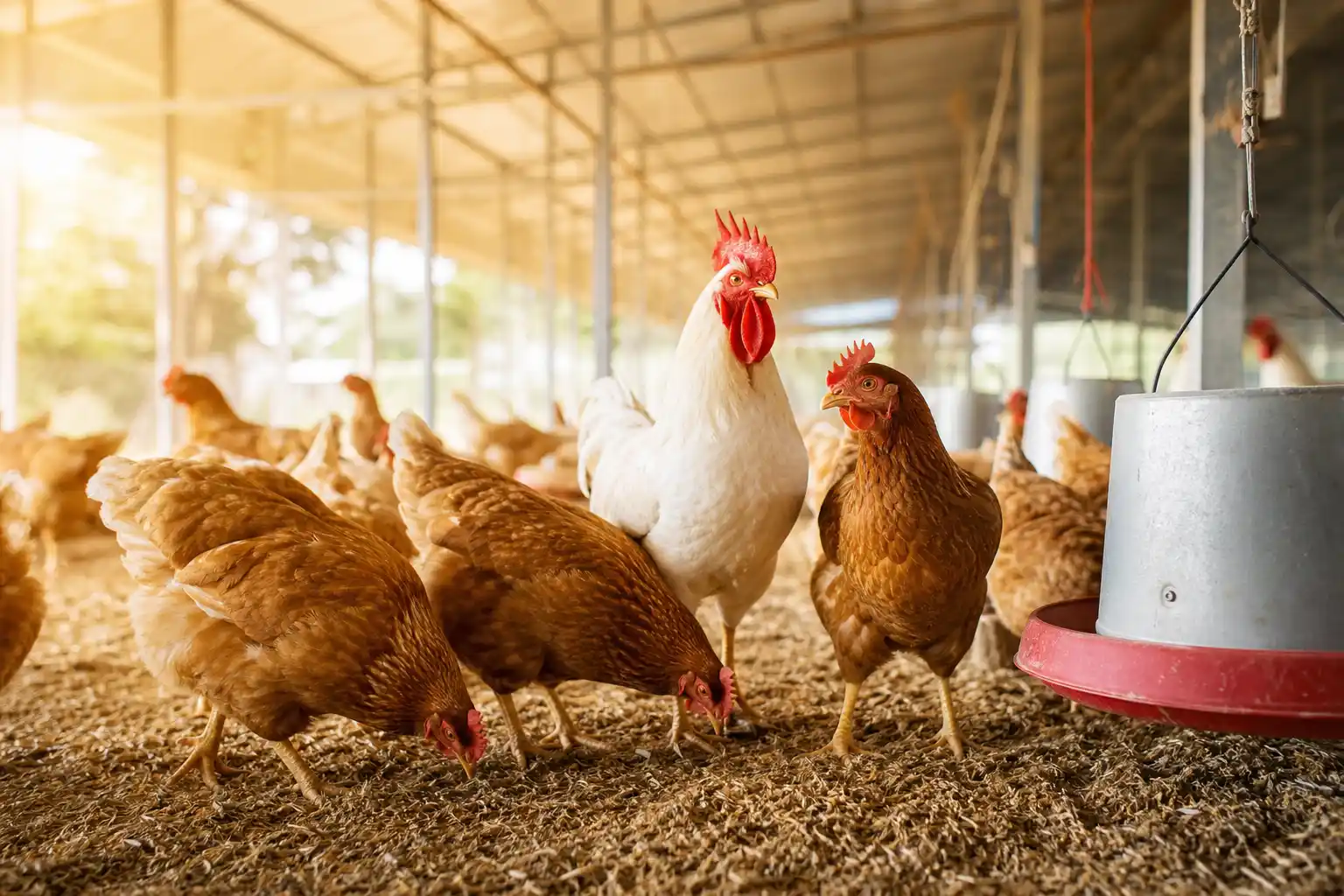
Supplements to Reduce Cost of Poultry Production
Rising feed costs have squeezed margins across the poultry industry. In my consulting work, I’ve seen operations look for every possible efficiency gain. Strategic feed supplementation can actually reduce overall production costs, even though it adds line items to the feed bill. The key is understanding where the return on investment is real.
The Economic Logic
Every dollar spent on a feed supplement needs to return more than a dollar in savings or revenue. The math is straightforward but often overlooked. Before recommending any supplement for cost reduction, I calculate the projected ROI based on realistic performance improvements.
The main areas where supplements can reduce costs:
- Feed conversion ratio improvement
- Mortality reduction
- Medication cost reduction
- Processing yield improvement
- Litter quality and environmental management
Enzymes to Improve Nutrient Utilization
Enzymes are the most reliable cost-reducing supplements because they directly improve feed efficiency. Phytase is the classic example — it releases phosphorus bound in phytate, reducing the need for added inorganic phosphate.
A good phytase at 500 FTU/kg can replace 0.12-0.15% available phosphorus in the formulation, saving $2-4 per ton of feed. With current phosphate prices, the ROI is typically 5:1 or better.
Carbohydrase enzymes (xylanase, glucanase, cellulase) improve energy utilization from grains. A multi-carbohydrase product typically saves 80-120 kcal/kg of feed, which translates to $3-6 per ton in saved fat or oil. In my experience, the response is more consistent in wheat and barley diets than in corn-based diets.
Protease enzymes improve protein digestibility by 3-5%, reducing the need for expensive protein sources. At $1-2 per ton inclusion cost, protease typically returns $4-8 per ton in saved soybean meal or synthetic amino acids.
Probiotics for Gut Health and Mortality Reduction
Gut health supplements reduce production costs primarily through mortality reduction and improved uniformity. In flocks with average mortality of 4-5%, a good probiotic program typically reduces mortality by 0.5-1.5 percentage points.
The economic impact of mortality is often underestimated. A dead bird represents all the feed it consumed, plus the lost revenue opportunity. In a typical broiler operation, reducing mortality from 5% to 3.5% at a cost of $1-2 per ton for probiotics returns $5-10 per ton.
Probiotics also improve flock uniformity, which increases processing plant efficiency. Birds that are closer to target weight at processing require fewer sort-outs and reprocessing. This is a real but often unmeasured benefit.
Organic Acids as Medication Replacement
Organic acids and medium-chain fatty acids can partially replace the growth-promoting effects of antibiotic growth promoters. In antibiotic-free programs, the cost of disease outbreaks is substantial.
A good organic acid program costs $3-6 per ton of feed. In my experience across multiple operations, this investment reduces the need for therapeutic medication by 30-50%, saving $8-20 per ton in medication costs alone. The savings in veterinary costs and mortality are additional.
Betaine to Replace Choline
Betaine can partially replace choline chloride in feeds because it functions as a methyl donor. Choline chloride is hygroscopic and can cause handling issues, and it’s also less efficient as a methyl donor than betaine.
Replacing choline chloride with betaine on an equimolar basis typically saves $0.50-1.50 per ton while improving performance. Betaine also provides osmotic protection benefits that choline does not.
Mycotoxin Binders for Loss Prevention
Mycotoxin contamination is a hidden cost in many operations. Even low-level contamination that doesn’t cause clinical signs can reduce performance by 3-5%. Mycotoxin binders are an insurance policy.
A good broad-spectrum mycotoxin binder costs $2-4 per ton. When mycotoxin challenges are present, the ROI is typically 10:1 or higher. When contamination is absent, the binder is a sunk cost. The key is matching the binder type to the mycotoxin risk profile of your region and grain sources.
Practical Implementation
For operations looking to reduce costs through supplementation, I recommend starting with:
- Phytase — the highest ROI supplement available
- A multi-carbohydrase enzyme for energy savings
- Probiotics for mortality reduction
- Mycotoxin binders as risk management
These four products, used correctly, typically return $15-30 per ton of feed in combined savings, far exceeding their inclusion cost.
Summary
Strategic supplementation reduces production costs by improving feed efficiency, reducing mortality, and decreasing medication needs. The key is calculating ROI upfront and measuring results in your own operation. What works for one farm may not work for another, but enzymes and gut health supplements have consistently shown positive returns across most production systems.