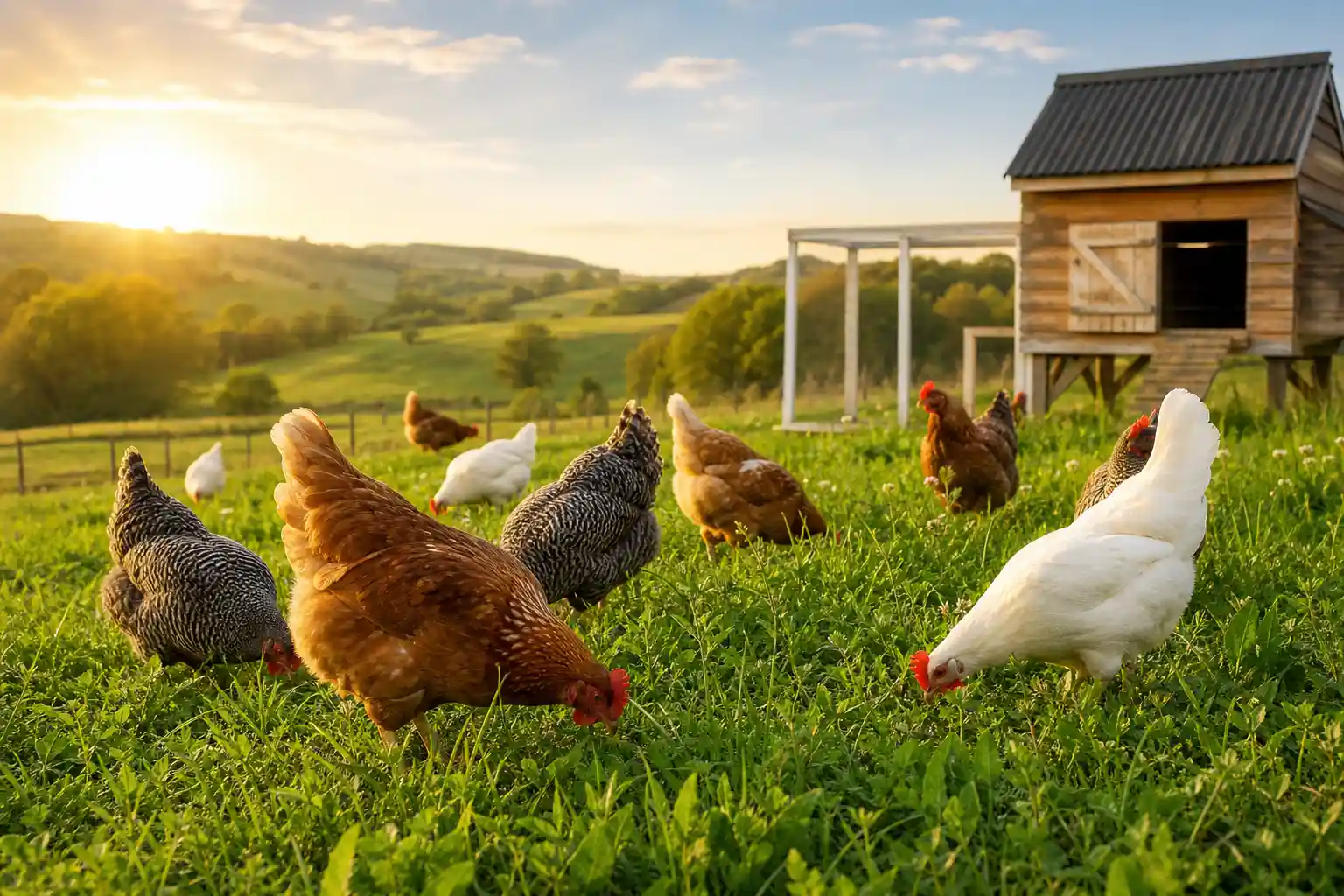
Supplementing Poultry on Pasture: What Changes in the Diet
Pasture-raised poultry has different nutritional needs than birds raised in confinement. Foraging provides some nutrients but also increases energy expenditure and environmental exposure. I’ve worked with several pasture-based operations and found that the supplement program needs adjustment.
What Foraging Provides
Birds on good pasture consume a variety of plants, insects, and soil organisms. A typical pasture provides:
- Green forage: Leaves and tender stems provide vitamins A, E, and K, along with some calcium and trace minerals. Good pasture can supply up to 10-15% of the bird’s total feed intake.
- Insects and worms: These provide high-quality protein and fats. Depending on stocking density and pasture quality, insects can provide 5-10% of daily protein.
- Grit and soil: Birds ingest small stones and soil particles that aid digestion and provide trace minerals.
The contribution of pasture to nutrition is often overstated by pasture-raised enthusiasts. In my measurements, even the best pasture provides no more than 15-20% of a bird’s nutritional needs. The rest must come from supplemented feed.
Nutrient Adjustments
Energy. Pasture birds are more active, so their energy requirement is 5-10% higher than confined birds. I recommend a feed with 2,900-3,000 kcal/kg for growing birds and 2,800-2,900 kcal/kg for layers on pasture.
Protein. Foraging provides some protein from insects, but the amount is unpredictable. I maintain protein at 18-20% for growers and 16-17% for layers on pasture, the same as for confined birds.
Methionine. The first limiting amino acid for both growth and egg production. Insects provide some methionine, but I keep supplemental methionine at standard levels. The feather quality benefits alone justify adequate methionine in pasture flocks.
Calcium. Pasture provides negligible calcium. Layer feeds must still contain 3.5-4.0% calcium with coarse particle distribution. Free-choice oyster shell is even more important on pasture where the hen’s movements increase calcium demands for bone strength.
Vitamin E. This is one area where pasture has an advantage. Fresh green forage provides natural vitamin E and other antioxidants. I can reduce supplemental vitamin E slightly (to 30-40 IU/kg) in birds on good pasture during the growing season.
Seasonal Variation
Summer. Best foraging conditions. Pasture provides maximum nutritional contribution. I reduce feed allowance slightly (by 5-10%) to match the reduced energy requirement.
Winter. Pasture is dormant. Very little foraging value. Birds are fully dependent on supplemented feed. I increase feed to standard levels and ensure adequate vitamin D3 (no sunlight synthesis in winter).
Rainy periods. Wet pasture encourages parasites. I increase vitamin and mineral levels to support immune function during wet weather.
Predator and Parasite Protection
Pasture birds face more parasite exposure than confined birds:
- Coccidiosis. Pasture birds are almost always exposed. I use a coccidiosis vaccine or a rotational deworming program.
- Internal parasites. Roundworms and tapeworms are common in pasture flocks. Regular fecal testing and targeted deworming are essential.
- External parasites. Mites and lice are more common in pasture birds. Diatomaceous earth in dust baths or permethrin treatment as needed.
Supplementation alone cannot control parasites. Good pasture rotation and sanitation are more important.
Pasture Management
The supplement program is only as good as the pasture management:
- Rotation. I recommend moving birds to fresh pasture every 3-7 days. This breaks parasite cycles and maintains forage quality.
- Stocking density. Maximum 500-1,000 birds per acre for non-rotated pasture. Rotated pasture can handle 1,000-2,000 birds per acre.
- Rest period. Pasture should rest 30-60 days between bird rotations to regrow and break disease cycles.
- Sunlight. Direct sunlight on the pasture helps reduce pathogen loads and supports vitamin D synthesis.
Feed Form
Pasture birds are often fed in open feeders rather than in confined feeding systems. The feed form matters:
- Pellets are preferred for pasture birds because there is less waste from wind and spillage
- Crumbles are also good but produce more fines
- Mash is not recommended for outdoor feeding because wind blows it away and birds selectively consume particles
I recommend pellet feeding for pasture operations. The extra cost of pelleting ($5-10/ton) is offset by reduced waste.
Pasture poultry production can be profitable and produce excellent meat and eggs. The key is recognizing that pasture provides a supplement to good feed, not a replacement for it.